Professional vs. DIY Screw Piles: Why "Big Box" Kits Aren't Worth the Risk
We get it. The DIY spirit is strong in Alberta. There is a certain satisfaction in heading to the local big-box hardware store, grabbing a few supplies, and tackling a weekend project. But while DIY is great for tiling a backsplash or building a planter box, your foundation is a different beast entirely.
Lately, we’ve seen an influx of "manual" screw pile kits in retail aisles. They look simple enough: a small steel rod with a thin flighting that you’re supposed to turn into the ground using a 2x4 or a metal bar.
Before you grab a wrench and start twisting, let’s look at why the debate between professional vs DIY screw piles isn't just a matter of labor—it’s a matter of physics and safety.

The Depth Deficit (The 7-Foot Rule)
In Calgary, the frost line isn't a suggestion; it’s a law of nature. To prevent your deck from heaving and "walking" away from your house, your foundation must sit well below the frost line—typically 6 to 7 feet deep.
The DIY Issue: Most manual kits are only 3 to 4 feet long. Even with extensions, the physical effort required to hand-turn a pile through 7 feet of dense Alberta clay is nearly impossible for a human being.
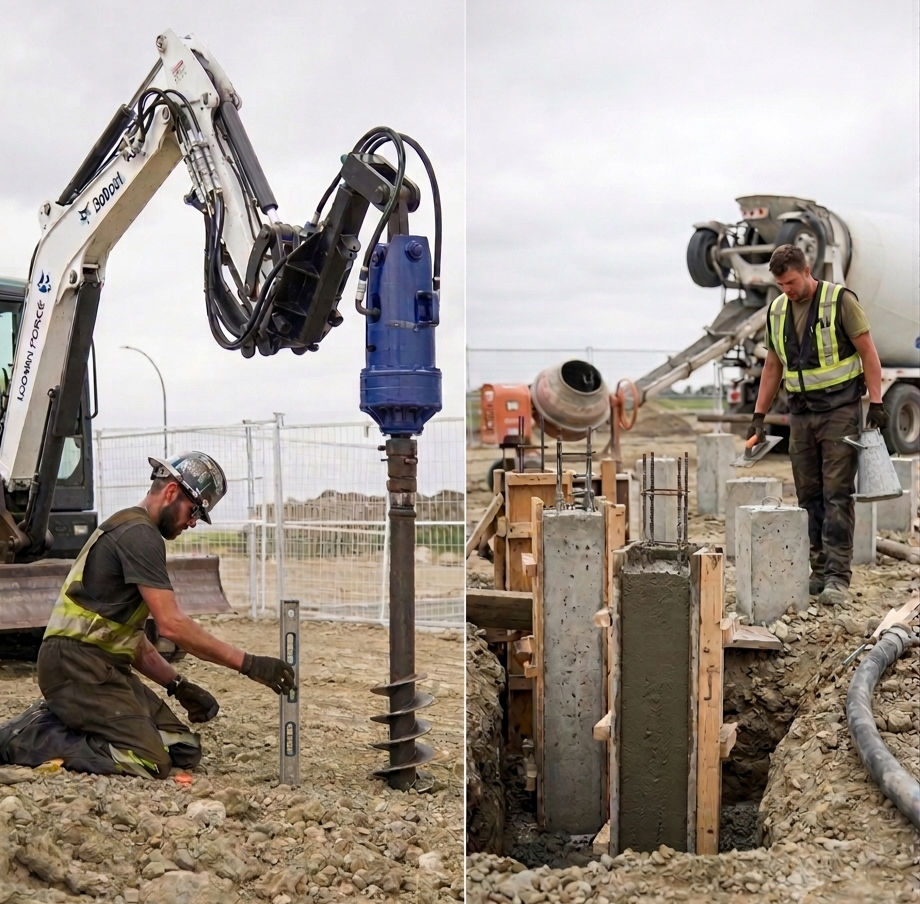
The Professional Edge: Our hydraulic drive heads exert thousands of foot-pounds of pressure. We don’t stop until we hit the depth required by your specific soil profile.
Torque vs. "Tug"
The strength of a screw pile isn't determined by how hard you can pull on a 2x4. It’s determined by installation torque. Professional installers use digital torque monitors to measure the resistance of the soil in real-time. This resistance tells us exactly how much weight that pile can hold.
With a DIY kit, you are guessing. With a professional install from Down Force Piling, you get a documented torque report. You know that pile can hold 5,000 lbs because the physics says so.
The "Thin Steel" Problem
To make DIY kits light enough to sit on a retail shelf, they are often made of thinner, lower-grade steel with smaller "flights" (the screw part).
Longevity: Thin steel corrodes faster. Professional-grade piles are heavy-wall, hot-dip galvanized steel designed to last for 50+ years.
Stability: A small 4-inch flighting on a DIY pile doesn't have the surface area to "grip" the soil. A professional pile uses engineered helices (usually 8 to 12 inches) that act like a massive anchor.
Comparison at a Glance: Professional vs. DIY Screw Piles
Feature | DIY Manual Kits | Down Force Professional Piling |
Typical Depth | 3–4 feet (Above frost line) | 7–10+ feet (Below frost line) |
Installation Method | Manual labor / Hand tools | High-torque hydraulic machinery |
Load Verification | Visual guesswork | Real-time digital torque monitoring |
Steel Quality | Lightweight / Thin-wall | Heavy-duty / Hot-dip galvanized |
Building Code | Often fails inspection | Fully CCMC certified & engineered |
4. Building Permits and Engineering
If you are building a deck or addition in Calgary that requires a permit, the city will often ask for an engineered foundation.
Most DIY kits do not come with the CCMC (Canadian Construction Materials Centre) certifications or the torque logs required to satisfy a building inspector. Choosing the DIY route might save you a few hundred dollars today, but it could cost you thousands in "re-work" if an inspector rejects your foundation or if your deck begins to sag in three years.
The Verdict: Your Foundation is No Place to Shortcut
If your project matters, its foundation matters. While DIY kits might work for a light garden fence or a temporary shed, they simply aren't designed for the structural loads and climate challenges we face in Alberta.
When you choose professional vs DIY screw piles, you aren't just paying for the steel—you’re paying for the peace of mind that comes with an engineered, guaranteed solution.
Don't risk your hard work on a "maybe." Contact Down Force Piling today for a quote on a professional foundation that will outlast the house it's built next to.