Everything You Need to Know About Screw Foundations in Calgary
Updated: Aug 20
Whether you're a homeowner planning a deck, a contractor bidding a commercial project, or just trying to understand your foundation options in Calgary, this guide covers everything. What screw foundations are, how they're installed, what they cost, when to use them, and why they're the right choice for Alberta's challenging soil and climate conditions.
Screw Foundations Screw Foundations Screw Foundations Screw Foundations
What Are Screw Foundations?
Screw foundations, also called helical piles, helical piers, screw piles, or helical anchors, are engineered steel foundation elements used to support structures in place of traditional poured concrete footings. They consist of a central steel shaft with one or more helical (spiral) plates welded at the base. The helix acts exactly like a screw thread, allowing the pile to be mechanically driven into the earth.
The result is a deep, stable foundation anchor that transfers structural loads down through weak or unstable surface soils into the firm ground below. They've been used in commercial and civil engineering applications for decades, and over the past 15 years, screw foundations have become the preferred residential foundation solution across Western Canada, and particularly in Calgary.
The Anatomy of a Screw Pile
Technical Specifications
Central Steel Shaft
Material: High-strength carbon steel (ASTM A252 Grade 3)
Diameter: Typically 2⅞" to 5-1/2"
Wall Thickness: 0.203" to 0.375"
Function: Transfers structural loads to soil
Helical Bearing Plates
Shape: Spiral (like a screw thread)
Diameter: 8" to 20" (soil-dependent)
Quantity: 1-4 plates per pile
Purpose: Provides bearing surface in stable soil
How Screw Piles Actually Work
Load Transfer Mechanism
Installation: Rotated into ground until reaching required torque
Load Path:
Structure → Pile Cap → Shaft → Helix Plates → Stable Soil
Screw Pile Foundation/Design & Engineering Specifications
Key Components
Helical Plates: Typically 8" to 16" diameter (varies by load)
Shaft: Square or round steel (2⅞" to 4½" OD)
Galvanization: Hot-dip zinc coating (minimum 3.9 mils) for corrosion resistance
Load Capacity Standards
Residential: 10–50 kips/pile (varies with soil)
Commercial: Up to 200+ kips/pile (engineered solutions)
Testing: Each pile load-tested to 150% of design capacity
Soil Adaptability
Soil Type | Helix Configuration | Torque Requirements |
Clay | Single/multi-helix | 4,000–7,000 ft-lbs |
Sand | Multi-helix | 5,000–8,500 ft-lbs |
Rock | Rock-socket helix | 10,000+ ft-lbs |
How Do Screw Foundations Work?
The engineering principle behind screw foundations is straightforward: load transfer through helical bearing plates. As the pile is screwed into the ground, each helical plate cuts through the soil rather than disturbing it. When the pile reaches the target depth, the helix is embedded in undisturbed, competent soil that can bear the design load.
Because the pile installation process doesn't displace soil, it cuts through it, the surrounding soil retains its density and structure. This is especially important in Calgary, where clay soils can be unstable near the surface. The deeper you go, the more stable and load-bearing the soil becomes, and screw foundations are specifically engineered to reach that stable layer.
Load capacity is verified directly during installation through real-time torque monitoring. The hydraulic drive machine tracks the torque required to rotate the pile at every increment of depth. There's a well-established relationship between installation torque and pile capacity, so by the time the last pile is driven, the engineer already knows the foundation is performing to specification.
The Installation Process
One of the defining advantages of screw foundations is how fast and clean the installation process is. Here's what it looks like on a typical Calgary residential project:
Site assessment and engineering. Your project is reviewed by an engineer who determines pile spacing, diameter, depth, and helix configuration based on your structure's design loads and soil conditions at your specific location.
Pile layout and positioning. Pile locations are marked on your site according to the engineering drawings. For most residential projects, this takes under an hour.
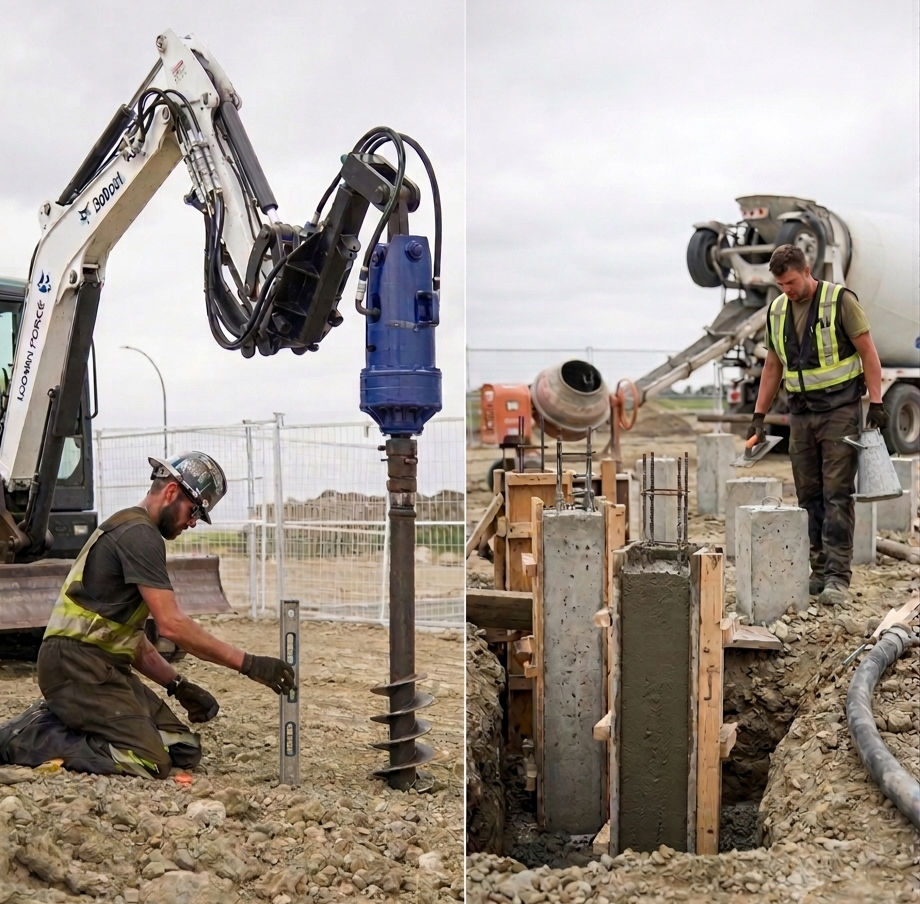
Hydraulic drive installation. A drive head mounted to an excavator or skid steer rotates each pile into the ground. The operator monitors torque readings in real time. Each pile takes minutes to install.
Cut-off and cap installation. Once driven to depth, each pile is cut to the finished elevation and fitted with a bearing cap or bracket specific to your structural connection type, beam, post, grade beam, etc.
Load verification and documentation. Torque data is compiled into an installation report. Where required, this is used to support engineering sign-off and permit applications.
Construction begins. That's it. Your framing crew can start immediately. No waiting.
A typical residential screw foundation installation, 6 to 12 piles for a deck, suite, or home addition, is complete in a single day. Most crews are on-site for 4 to 8 hours from first pile to final cap.
Why Screw Foundations Are the Right Choice for Calgary's Soil and Climate
Calgary is a challenging place to build. The soil and climate conditions here create real problems for conventional concrete foundations that screw foundations solve particularly well.
Clay-rich, expansive soils
Much of Calgary sits on glacial till and clay-rich soils that expand when wet and contract when dry. This movement is hard on concrete, which is strong in compression but weak in tension, meaning it can crack when the ground shifts. Steel screw piles resist both compression and bending forces, giving them a structural advantage in Calgary's specific soil conditions.
Calgary's deep frost line
Calgary's frost line runs 6 to 8 feet below grade. Foundations that don't reach below the frost line are vulnerable to frost heaving, seasonal movement caused by freezing ground that can lift and shift concrete piles over years of freeze-thaw cycles. Screw foundations are always installed below the frost line, eliminating this risk.
Year-round construction demand
Calgary's construction season is compressed, but project demand doesn't stop in November. Screw foundations can be installed in frozen ground, through snow, in sub-zero temperatures, conditions that make concrete pours impractical or impossible without expensive cold-weather protection measures. Builders who use screw foundations can start projects earlier in spring and extend work later into fall and winter.
Variable soil conditions across Calgary
Soil conditions in Calgary vary significantly by neighborhood and lot. Screw pile installation adapts naturally to variable ground, torque monitoring detects soil transitions in real time, and pile lengths can be adjusted on the fly to ensure every pile reaches competent bearing material, regardless of what's beneath a specific location.
What Projects Use Screw Foundations in Calgary?
Decks and patios: the most common application, both uncovered and covered. City of Calgary standard designs are available for uncovered decks.
Home additions: sunrooms, mudrooms, master suite extensions. Grade beam and screw pile systems provide code-compliant foundations for additions of all types.
Detached garages: grade beams supported on screw piles replace traditional continuous footings, faster and more cost-effective.
Garden suites and backyard housing: increasingly popular in Calgary. Screw pile foundations are the standard approach for secondary suites on residential lots.
Foundation repair and underpinning: remedial work for settling foundations. Minimal excavation and precision installation restore stability with little disruption.
Light commercial builds: engineered pile systems for commercial structures with stamped drawings and torque reports for permit compliance.
Retaining walls: helical tiebacks and anchor systems to support retaining walls and slope stabilization.
Ground-mounted solar installations: quick, economical, and stable for large panel arrays that can't move with seasonal ground change.
Project Type | Details |
Decks and patios | Most common application, both uncovered and covered. City of Calgary standard designs available for uncovered decks. |
Home additions | Sunrooms, mudrooms, master suite extensions. Grade beam and screw pile systems provide code-compliant foundations. |
Detached garages | Grade beams on screw piles replace traditional continuous footings faster and more cost-effective. |
Garden suites and backyard housing | Increasingly popular in Calgary. Screw pile foundations are the standard approach for secondary suites. |
Foundation repair and underpinning | Remedial work for settling foundations. Minimal excavation, precise installation, little disruption. |
Light commercial builds | Engineered pile systems with stamped drawings and torque reports for permit compliance. |
Retaining walls | Helical tiebacks and anchor systems for retaining walls and slope stabilization. |
Ground-mounted solar installations | Quick, economical, and stable for large panel arrays that can't shift with seasonal ground change. |
Screw Foundations vs. Concrete Footings
Factor | Screw Foundations | Concrete Footings |
Installation speed | Hours to 1 day | 2–4 days (excavation, forming, pour) |
Cure and wait time | None — immediate load bearing | 7–28 days |
Winter installation | Fully capable year-round | Extremely difficult, costly cold-weather measures required |
Frost heave resistance | Excellent — installed below frost line | Poor — piles can crack at the frost line |
Soil compatibility | Adapts to variable soils, torque confirms bearing | Requires relatively uniform, stable bearing soil |
Tensile strength | Strong — steel resists bending and tension | Weak in tension, vulnerable to cracking |
Site disturbance | Minimal | Significant — excavation, formwork, backfill, cleanup |
Load verification | Real-time on-site torque monitoring | Lab testing of cylinders — results days later |
Typical cost | 20–30% less than concrete on comparable projects | Higher labour, excavation, and waiting costs |
Lifespan | 50+ years with hot-dip galvanized coating | Variable — prone to cracking in Calgary's expansive soils |
Removability | Can be extracted and repositioned if needed | Permanent — cannot be removed without demolition |
FAQ
How long does screw pile foundation installation take?
Most residential projects complete in 1-2 days; commercial in 2-5 days.
Are screw piles suitable for all soil types?
Yes, we customize helix configurations for:
Clay
Sand
Rock
High water table areas
What maintenance do screw pile foundations require?
None - galvanized steel requires no regular maintenance.
How do screw piles compare to concrete for cost?
Typically 20-40% more economical when considering:
Labor savings
No curing time
Reduced equipment needs
Can screw piles be used for foundation repairs?
Yes, they're ideal for:
Lifting settled structures
Stabilizing failing foundations
Adding support to existing buildings
Why Choose Downforce Piling for Your Screw Foundation in Calgary?
Downforce Piling specializes exclusively in helical screw pile foundations. That focus means our installation teams are faster, our engineering relationships are stronger, and our project turnaround is tighter than general contractors who offer screw piles as one of many services.
Every installation includes a thorough site and soil assessment, real-time torque monitoring and per-pile capacity documentation, stamped engineering drawings for projects that require them, installations that meet or exceed Alberta Building Code standards, and year-round availability through Calgary winters.
Whether your project is a backyard deck or a multi-suite residential development, we size our approach to your job and deliver foundations you can build on, today, not next month.