
Screw Piles vs. Concrete Piles: Which Foundation Is Right for Your Alberta Project?
If you've been getting quotes for a new deck, home addition, RTM build, or any project that needs a foundation, you've probably heard two options come up: screw piles or concrete piles . Both go in the ground. Both hold things up. Beyond that, they're very different — and choosing the wrong one can cost you time, money, and headaches.
At Down Force Piling, we install screw piles exclusively. We're not going to pretend we're unbiased. But we're also going to be straight with you about exactly why — based on real project experience across Calgary, Southern Alberta, and beyond.
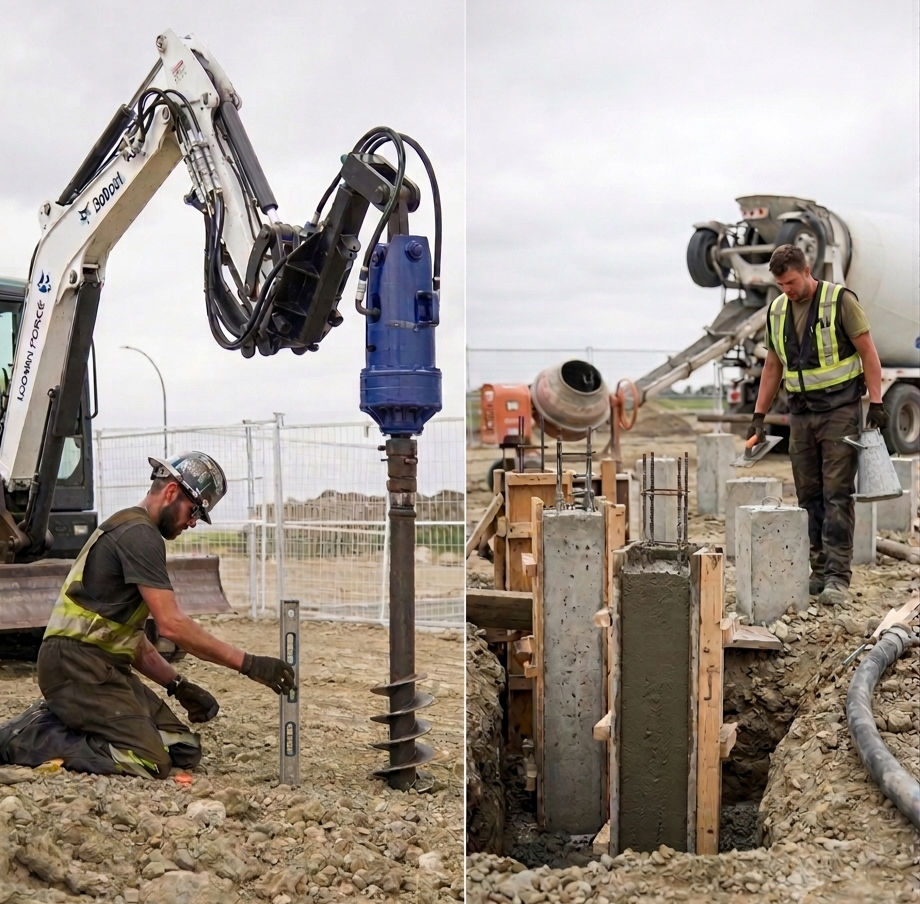
Screw Piles vs Concrete Piles Alberta
What Are Screw Piles?
A screw pile (also called a helical pile or helical pier) is a steel shaft with one or more helix-shaped plates welded to it. We use a hydraulic head mounted on an excavator or skid steer to rotate the pile into the ground, advancing it like a giant screw until it reaches the required depth and torque resistance.
That torque resistance is the key. It tells us — and our engineer — that the pile has reached load-bearing soil. Every job we do is engineered, meaning the pile diameter, helix size, and install depth are calculated for your specific project and site conditions before we ever set foot on your property.
What Are Concrete Piles?
Concrete piles (often called sonotubes, sono piers, or concrete piers) are installed by drilling a hole in the ground, dropping in a cardboard or fibre tube form, and pouring concrete into it. Once the concrete cures — typically 24 to 72 hours minimum — the form is removed and construction can begin.
Concrete has been the traditional choice for decades. It works. But "it works" is doing a lot of heavy lifting in that sentence.
Screw Piles vs. Concrete: The Real Comparison
1. Installation Speed
Screw piles: A typical residential job — say, 10 to 15 piles for a deck or garage — takes a single day. Sometimes less. We show up, install, and leave a site that's ready to build on immediately.
Concrete piles: Drilling the holes is fast. But then you wait. Concrete needs time to cure before it can bear load — minimum 24 hours, and in Alberta's variable temperatures, often longer. Cold weather can slow or compromise the cure, which means delays and added cost for heated enclosures or blankets.
Winner: Screw piles — by a full working day (or more).
2. Performance in Alberta Soil and Climate
This is where screw piles genuinely have no competition in our market.
Alberta soil is a mix of clay, till, and sand depending on where you are — and it freezes hard every winter. Freeze-thaw cycles are brutal on concrete piers. When the ground heaves in winter and thaws in spring, concrete piles can shift, crack, or lose their load capacity over time. That's why you see decks and outbuildings that look slightly off-level after a few Alberta winters.
Screw piles are installed deep enough to reach stable, frost-free soil. They're not affected by frost heave the way shallow concrete piers are. The steel moves with the ground without cracking, and the helix plates lock into load-bearing soil that doesn't shift with the seasons.
Winner: Screw piles — Alberta's freeze-thaw cycles are exactly what screw piles were designed for.
3. Winter Installation
Screw piles: We install year-round. When the ground is frozen, we pre-drill with an auger to break through the frost layer, then drive the pile to depth. Cold weather does not shut us down. We've installed piles at -30°C. The job gets done.
Concrete piles: Pouring concrete in freezing temperatures is a problem. Fresh concrete can freeze before it cures, which compromises strength. You either wait until spring, pay for heating, or accept a weaker product. Most concrete contractors in Alberta take a hard pause through the winter months.
Winner: Screw piles — not even close for year-round Alberta construction.
4. Cost
This one is more nuanced than most people expect.
Screw piles have a higher upfront material cost than concrete forms and mixed concrete. But when you factor in:
Faster installation (less labour time on site)
No wait time before building (keeps your project schedule tight)
No need for heated enclosures in winter
Engineering included in the pile price (with Down Force)
Longer service life with no frost-heave degradation
...the total project cost often comes out comparable or lower than concrete, particularly on larger jobs or jobs scheduled outside of peak summer months.
For small projects like a basic 10x12 deck? Concrete sonotubes may still be the cheaper upfront option if you're doing it yourself in mid-July. For anything larger, on a schedule, or in fall/winter — screw piles typically win on total cost.
Winner: Depends on project size and timing. Screw piles win on total value for most professional builds.
5. Environmental Impact
Concrete production is one of the largest sources of CO₂ emissions globally. Screw piles use significantly less material overall, can be removed and reused if a structure is ever decommissioned, and leave virtually no ground disturbance beyond the pile itself.
If your project has sustainability requirements — or you just prefer a cleaner install — screw piles are the lower-impact choice.
Winner: Screw piles.
6. Versatility
Screw piles can be installed in tight access areas, on slopes, in wet ground, and in locations where a concrete truck can't reach. They work for decks, garages, home additions, RTM and modular homes, solar arrays, docks, signs, and commercial structures.
Concrete piers require access for a drill rig and a concrete truck — or a lot of manual labour mixing bags. They're also less adaptable to complex load requirements without significant engineering overhead.
Winner: Screw piles.
Head-to-Head Summary
Screw Piles | Concrete Piles | |
Install time | Same day | 1–3+ days (cure time) |
Winter installation | Yes, year-round | Limited / not recommended |
Alberta frost heave | Resistant | Vulnerable |
Engineering included | Yes (with Down Force) | Often extra cost |
Environmental impact | Lower | Higher |
Tight access installs | Yes | Limited |
Removable / reusable | Yes | No |
Upfront cost | Moderate–higher | Lower–moderate |
Total project value | High | Variable |
What Type of Projects Are Screw Piles Best For?
Screw piles are the right choice for virtually every application we see in Alberta:
Residential decks and pergolas: fast install, no permit delays from cure time
Garages and outbuildings: engineered for load, no frost movement
Home additions and underpinning: stabilize and lift existing structures
RTM and modular homes: a purpose-built page on our site covers this in detail
Solar arrays: adjustable, precise, minimal site disruption
Commercial and industrial builds: engineered for heavy load requirements
Docks and marine structures: works in wet and saturated ground
Fences, signs, and light poles: efficient for high-volume installs
When Would We Recommend Concrete Instead?
Honestly? If you're a homeowner doing a small DIY deck in the middle of summer and you have time to wait for cure, concrete sonotubes are a legitimate option you can rent equipment for and do yourself.
Beyond that scenario, we haven't seen a project type where screw piles don't outperform concrete on the factors that matter: speed, reliability, longevity, and performance in Alberta conditions.
Ready to Get a Quote?
Down Force Piling serves Calgary, Southern Alberta, and surrounding areas. No surprises on price.
Call us at (403) 910-5516 or get a quote online at downforcepiling.ca/get-a-quote.


