Can Screw Piles Be Installed in Frozen Ground?
Short answer: yes. We do it all the time.
If you've been putting off a foundation project because it's November, or because the ground has already frozen, you don't need to wait until spring. Screw piles can be installed through frozen ground, and at Down Force Piling we work year-round — including through Alberta winters that most contractors use as an excuse to shut down.
Here's how it actually works, and why it matters for your project.

Why Most Foundation Work Stops in Winter
The reason concrete foundations grind to a halt in cold weather is straightforward: fresh concrete doesn't cure properly when it's freezing. If the temperature drops below zero while concrete is setting, you risk a weakened pour — which means delays, extra costs for heated enclosures, or worse, a compromised foundation.
So contractors stop. Builders wait. Projects get pushed to spring and the whole schedule backs up.
Screw piles don't have that problem.
How We Install Screw Piles Through Frozen Ground
The process is pretty much the same as a warm-weather install, with one extra step at the start.
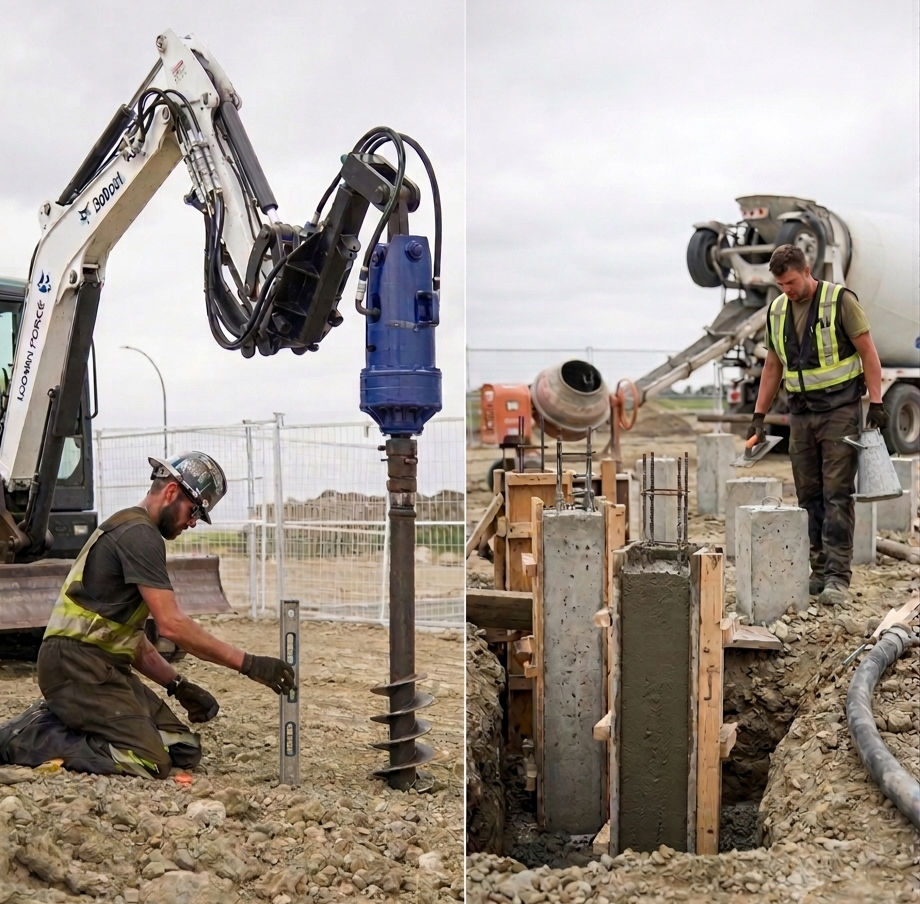
When the ground is frozen, we pre-drill through the frost layer using an auger before driving the pile. This breaks through the hardened surface and opens up the path for the pile to advance into the soil below — where the ground isn't frozen and load-bearing conditions are normal.
From there, it's the same as any other installation. We rotate the pile down to the required depth using a hydraulic head mounted on our equipment, monitor the torque as we go, and stop when we've hit the engineered resistance for your project. The frost at the surface doesn't change what's happening deeper in the ground, and it doesn't change what the pile can hold.
We've installed piles at -30°C. The crew shows up, the work gets done, and you're ready to build.
Does Cold Weather Affect Screw Pile Performance?
No — and this is one of the reasons screw piles are genuinely well-suited to Alberta's climate.
The piles are driven deep enough to reach soil below the frost line, which in most of Southern Alberta sits somewhere between 1.2 and 1.8 metres depending on your location. The helix plates anchor into that stable, unfrozen soil. Once the pile is in and the ground thaws in spring, nothing shifts, nothing loosens. The pile stays exactly where it was installed.
This is actually the opposite problem from what shallow concrete piers face. Concrete piers that don't reach below the frost line are vulnerable to heave — the freeze-thaw cycle lifts them slightly every winter and drops them every spring, which over time causes the structure above to rack, settle unevenly, or crack. It's a slow and expensive problem.
Screw piles bypass all of that. The depth is the solution.
What About the Steel? Does Cold Make It Brittle?
It's a fair question. Steel does behave differently at extreme temperatures, and Alberta gets cold enough that it's worth knowing.
The piles we use are manufactured to handle the temperature range we work in. Standard structural steel used in screw piles is rated well below the temperatures you'll actually encounter on a job site in Southern Alberta. We've never had a cold-weather failure due to material brittleness, and it's not something that comes up in practice at the temperatures we deal with.
If you're working on a project with extreme engineering requirements and unusual temperature exposure, that's a conversation for the engineering phase — which is included in every job we do anyway.
Why This Matters for Your Project
The practical upside of year-round installation is bigger than most people realize.
Your schedule stays on track. If you're a builder or contractor with a project timeline, you don't have to build in a three or four month weather window. We can install in October, November, December, January — whenever you need it done.
You can book ahead. Spring is our busiest season because everyone who waited suddenly needs piles at the same time. If you're flexible about when you build, booking a winter install usually means faster service and more scheduling flexibility on our end.
RTM and modular homes often arrive in winter. Manufactured homes don't stop coming off the lot because it's cold outside. If your RTM is arriving in February, the foundation needs to be ready in February. We can make that happen.
You can move fast on a project you didn't plan for. Sometimes you buy a property in January, or a contractor slot opens up unexpectedly, or a structure needs emergency stabilization in the middle of winter. Screw piles are the only foundation option that doesn't require you to wait.
What We Need From You to Make a Winter Install Work
Not much, honestly. The main thing that slows down a winter install is access — if your site has deep snow or a driveway that hasn't been plowed, we need to be able to get equipment in.
Beyond that, here's what helps:
Give us the layout in advance. We'll work with your engineer or contractor to confirm pile locations before we arrive so we're not problem-solving on a cold job site.
Mark any utilities. Alberta One-Call locates are still required in winter, same as any other time of year.
Let us know about site conditions. If there's standing water that's frozen over, unusual fill, or any site-specific issues, a heads-up before we arrive keeps things moving.
That's really it. We'll handle the rest.
Does installing in frozen ground cost more?
Pre-drilling through frost adds a step, but for most residential jobs it doesn't significantly change the cost. We'll flag it on your quote if the conditions at your site make it a notable factor.
How frozen is too frozen?
We haven't found a limit in practice for Southern Alberta winters. Extreme permafrost conditions in the far north are a different engineering challenge, but for Calgary, Cochrane, Okotoks, Banff, and the surrounding region — we work through whatever winter throws at us.
Can I get a quote in winter for a spring build?
Absolutely. In fact we'd encourage it, spring books up fast and locking in your project over winter gives you the most options.
Does the pile have to cure or set after installation?
No. That's one of the key differences from concrete. A screw pile is load-bearing the moment it's installed. You can start building on it the same day.
Down Force Piling and Supply — (403) 910-5516 — downforcepiling.ca/get-a-quote
We serve Calgary, Cochrane, Okotoks, High River, Banff, Turner Valley, and communities across Southern Alberta, twelve months a year.