NW vs. SE: How Screw Piles Calgary Solve Local Soil Challenges
If you’ve lived in Calgary long enough, you know that "the backyard" means something very different depending on which quadrant you’re in. In the Northwest, you’re often fighting a literal mountain of rocks. In the Southeast, you’re dealing with "gumbo" clay that expands and contracts like it’s breathing.
When it comes to building a deck, addition, or sunroom, your foundation needs to understand these differences. That’s why screw piles Calgary have become the gold standard for local builders.
Here is the breakdown of how we tackle Calgary’s unique "Tale of Two Soils."
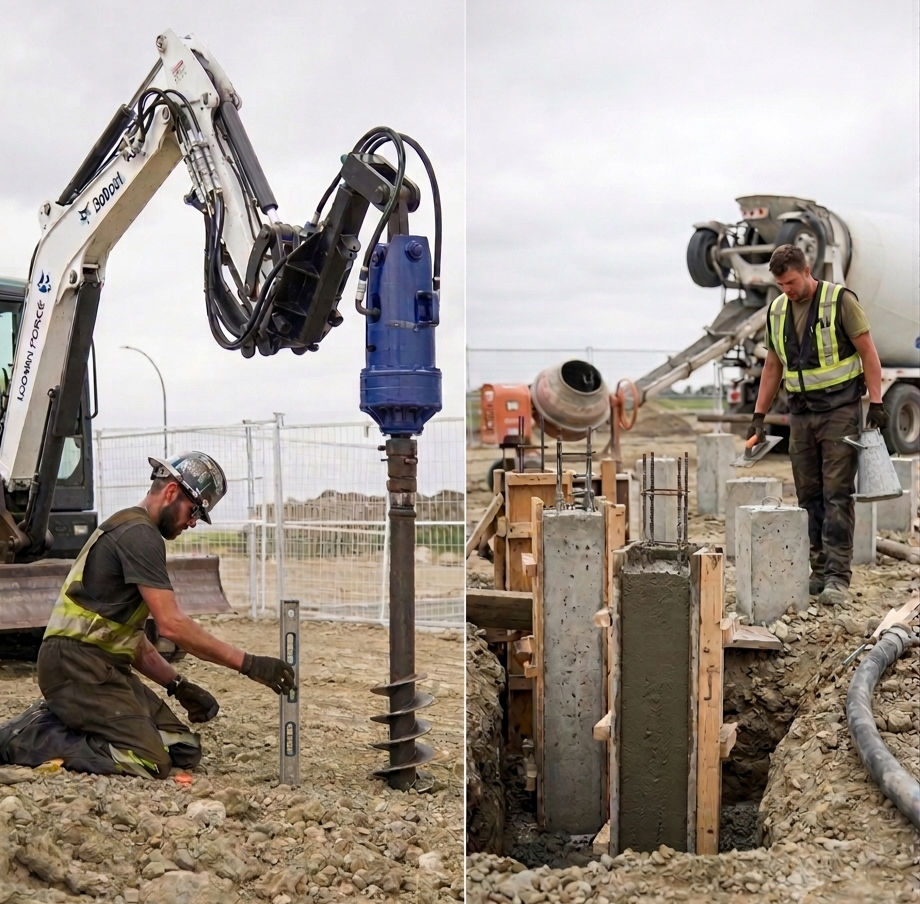
screw piling Calagary NW and SE screw piling Calagary NW and SE screw piling Calagary NW and SE screw piling Calagary NW and SE
The NW Challenge: Glacial Till and "Hidden" Boulders
The Northwest and parts of the West (think Rocky Ridge or Aspen Woods) are notorious for glacial till. This is a chaotic mix of silt, sand, and—most frustratingly—large rocks and cobbles left behind by retreating glaciers.
How Screw Piles Win in the NW:
The "Search" Method: Unlike a massive concrete pier that requires a 12-inch wide hole (and hits every rock in its path), a screw pile has a slim profile. It can often "slither" past smaller stones.
High-Torque Penetration: At Down Force Piling, we use high-torque hydraulic drive heads. This isn't your average DIY equipment. Our machines are designed to push through the dense, rocky till until they reach the required load-bearing capacity.
No Excavation Mess: In the NW, digging a traditional hole often turns into a mining operation. Screw piles are "screwed" in, meaning no giant piles of rocks and dirt on your pristine lawn.
The SE Challenge: The "Gumbo" Clay
In the Southeast and deep South (think Mahogany or Seton), the soil is dominated by heavy, expansive clay. This soil is a foundation's worst nightmare because it holds water. When that water freezes in a Calgary winter, the soil expands, creating frost heave that can snap concrete footings like toothpicks.
How Screw Piles Win in the SE:
Going Deep: To beat the "gumbo," you have to go deep. While the frost line is typically 6–7 feet, we often install screw piles Calgary to 10 feet or more to reach the stable, non-active clay layers.
The "Anchor" Effect: The helical blades at the bottom of the pile act as an anchor. Even if the top layers of clay expand and pull upward, the pile stays locked in the deep, stable soil.
Galvanized Protection: Clay is moisture-retentive and can be corrosive. We use hot-dip galvanized steel to ensure your foundation doesn't just stay stable, but also stays intact for 50+ years.
Why Torque is the Truth (The Technical Bit)
In both quadrants, we don't just "guess" when the pile is deep enough. We use real-time torque monitoring.
Capacity = K_t \times T
In this formula, $T$ is the installation torque and $K_t$ is the empirical torque correlation factor. Essentially, the harder it is to turn the pile into the ground, the more weight that pile can support. This gives you measurable proof that your foundation is solid, whether you’re sitting on NW rock or SE clay.
The Bottom Line for Calgary Builders Seeking Screw Piles
Choosing screw piles Calgary isn't just about speed; it's about matching the technology to the geography. Concrete is a "one-size-fits-all" solution that often fits none of Calgary's soil profiles perfectly. Screw piles are an engineered response to the ground you actually live on.
Building in a tricky Calgary quadrant? Contact Down Force Piling today for a site assessment. We know exactly what’s under your grass, and we have the torque to handle it.